A stronger chin, a squarer jaw.
In a man's face, the chin sets the width and the line of the entire lower third. Dr. Larry Nichter builds it with projection, height, and width in the proportions that read as masculine — a jawline that looks inherited rather than added.
Request a Private Consultation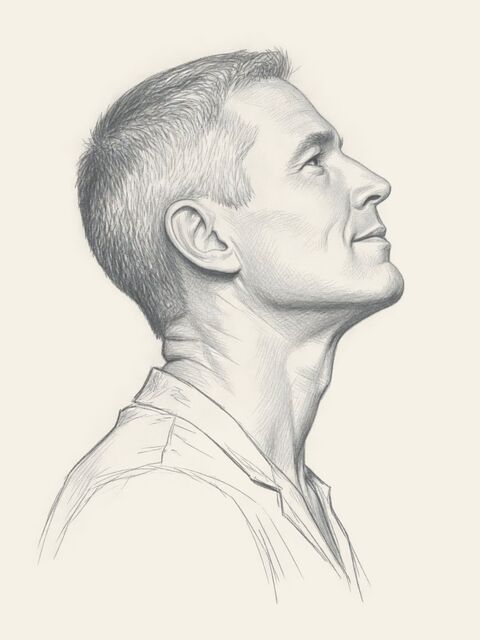
The procedure
Male Chin Augmentation in Newport Beach
Chin augmentation — genioplasty — permanently increases the size, shape, and projection of the chin, either with a solid silicone implant placed on the chin bone or by advancing the bone itself. Men make up a substantial share of the patients who have it done. It is one of the few facial procedures where a short operation produces a structural change that lasts for the rest of a man's life.
What men ask for is usually different from what women ask for, and the difference is not a matter of degree. A chin read as masculine has more forward projection, more vertical height, and — the point most often missed — more width. It is squarer through the front, with a defined corner where the chin turns back toward the jaw, rather than tapering to a point. Women more often want the opposite: a narrower, softer, more tapered chin. An implant that looks elegant on a woman can look undersized on a man, because it adds projection without adding width.
The mechanics of the operation — anesthesia, implant materials, healing, permanence — are covered in full on our chin augmentation page. What follows is what differs for men: how a masculine chin is shaped, how the chin relates to the jaw and neck in a male face, how incisions are planned around a beard, and how the result is judged.
His approach
Width, Not Just Projection

Chin implants are not one shape. A central implant sits over the front of the chin and adds projection alone, which is the shape more often chosen for women. Anatomic and extended implants are wider: they wrap around the front of the chin and taper back along the jawline, adding width and squaring the corners at the same time as they add projection. In men, that lateral extension is usually what separates a chin that is merely bigger from a lower face that is stronger. Dr. Nichter chooses among implant styles, widths, and projections for each patient rather than working from a single preferred implant, and sizes to the male skeleton — a larger, wider frame absorbs an implant that would overwhelm a smaller one.
He also treats the complaint carefully rather than literally. A man who says his chin is weak is often describing a combination: real chin recession, and fullness under the jaw that blurs the line between chin and neck. Adding projection without addressing the neck gives an incomplete result. Dr. Nichter assesses the chin, the jawline, and the angle between jaw and neck together, and where submental fat or lax skin is part of the picture he will discuss pairing augmentation with chin and neck liposuction or a neck lift. He looks at the nose in the same breath. A strong male nose reads larger over a recessive chin, which is why chin augmentation and male rhinoplasty are so often planned as one operation.
Where an implant is the wrong tool, he says so. A sliding genioplasty moves the patient's own chin bone forward on a plate, and it is the better choice when the advancement needed is large, when the chin needs to be lengthened or shortened vertically as well as brought forward, when there is meaningful asymmetry to correct, or when a man would simply rather not have an implant. It is a bigger operation with a longer recovery, and the trade-off is discussed openly. Either way the target is the same, and it is not a dramatic one: a lower face that looks like the jaw he should have had. If the result reads as a chin implant, it is the wrong result.
Is it right for you
Am I a Good Candidate for Male Chin Augmentation?
The men who do best with chin augmentation arrive with a specific observation about their own face — usually about the profile, or about how they photograph — and are in good general health with a fully developed facial skeleton. Age matters less here than in most facial surgery: men in their twenties come in because the chin has always been recessive, men in their fifties because the jawline that used to cover for it has softened.
Chin augmentation may be right for you if:
- Your chin sits behind your lower lip in profile, or slopes back toward the neck
- Your lower face looks narrow, and the jawline lacks a defined corner at the chin
- Your nose reads as large in profile, and you suspect the chin is part of the reason
- Fullness beneath the chin blurs the line between your jaw and your neck
- You want a structural change rather than a repeated treatment
- You are in good general health and do not smoke, or are willing to stop before surgery
Some men are better served by a different plan. A significant bite discrepancy or jaw misalignment belongs with an orthodontist or an oral and maxillofacial surgeon first, and lip protrusion or active gum disease can change the approach or rule out an intraoral incision. Where the real issue is a heavy neck rather than a short chin, augmentation on its own will underdeliver. Dr. Nichter examines all of this at consultation and will tell you plainly which part of your lower face is driving the concern — including when the answer is that surgery would not serve your goals.
What to expect
Your Chin Augmentation Experience
Consultation and Planning
Dr. Nichter examines your face in profile, three-quarter, and front view, because width shows in one and projection in another. He assesses how far the chin sits relative to the lower lip and nose, its vertical height, where the jawline loses its corner, and how much of the softness under the jaw is fat, skin, or muscle. From that he recommends an approach — implant style, width, and projection, or a sliding genioplasty — and tells you what each would and would not change.
This is also where combinations get decided. If the nose belongs in the plan, or liposuction beneath the chin, he explains what that adds to the operation and to the recovery. You leave with a clear plan and a realistic account of what your lower face will look like.
The Day of Your Procedure
Chin augmentation on its own is typically performed under local anesthesia with oral or IV sedation, though general anesthesia is available and is standard when it is combined with rhinoplasty or a neck lift. An implant placement takes roughly thirty to sixty minutes.
The incision goes in one of two places. A submental incision sits in the natural crease under the chin, on the underside of the jaw where it is not seen at conversational angles, and for men with facial hair it falls within the beard shadow. An intraoral incision inside the lower lip leaves no external scar, at the cost of a soft diet and careful oral hygiene while it heals. Through either, Dr. Nichter creates a precise pocket directly on the chin bone, positions the implant, and confirms symmetry and centering before closing with fine sutures.
A sliding genioplasty is performed through an intraoral incision under general anesthesia. The chin bone is cut, advanced to the planned position, and fixed there with a small plate and screws.
Immediately After
Sedation clears quickly and most men go home within an hour or two. A chin strap or light dressing supports the implant and limits swelling during the first days. Someone will need to drive you home.
Recovery
Recovery and Downtime
Chin augmentation has one of the shortest recoveries in facial surgery, which is part of why it suits men who cannot disappear for a month. Most are back at work inside a week.
The First Few Days
Expect swelling and tightness across the chin and lower lip, tenderness at the incision, and sometimes bruising that tracks down toward the jaw. Discomfort is usually mild and managed with prescribed or over-the-counter medication. Wear the chin strap as directed, generally for one to three days. Eat soft food to keep jaw movement down, and expect speech to feel slightly clumsy for a day or two. If your incision is under the chin, keep a razor away from it — shaving around a submental incision waits until Dr. Nichter clears it.
Week One
Swelling settles noticeably. Most men return to desk work and normal daily activity within five to seven days, still carrying enough residual swelling that the chin looks fuller than its final shape. For men who would rather not discuss the surgery, that is usually short enough to pass without comment. Keep chewing light, rinse as directed if the incision is intraoral, and protect the chin from pressure or a knock.
Weeks Two Through Six
The chin starts to look and feel like part of the face rather than something added to it. Light exercise can usually resume around week two once Dr. Nichter clears it, with heavy lifting, straining, and anything that puts your head below your heart added back gradually. Most visible swelling is gone by three to four weeks. Contact sports, sparring, and anything else that risks a direct hit to the chin stay out for the full six weeks, while the tissue capsule forms around the implant.
Six Weeks and Beyond
By six weeks the swelling has resolved, the implant has settled into its final position, and full activity resumes. The implant integrates with the surrounding tissue and comes to feel like the bone beneath it. A submental scar keeps fading over the following months and is difficult to find on most men, with or without facial hair over it. Recovery after a sliding genioplasty follows the same shape but runs longer; Dr. Nichter gives you a specific timeline if that is the plan.
Results
Permanent structure in the lower face.
The change in projection is visible as soon as the dressing comes off, but the shape you will keep appears at four to six weeks, as swelling leaves the chin and the width and corners of the jawline become legible. Men often notice it first in photographs, where the profile and three-quarter angles they used to avoid stop being a problem.
The result is permanent. A solid silicone implant does not break down or need routine replacement, and a genioplasty advancement is bone that has healed in its new position. Aging continues around it — skin loosens, the neck changes — but the projection and width stay where they were put, which is why a chin augmented in a man's thirties still holds the jawline in his sixties. A good outcome is one where people register a stronger jaw and cannot say what changed.
This 28-year-old gentleman had a Chin Augmentation.
This gentleman had a Chin Augmentation and Blepharoplasty (Eyelid Lift).
Investment
Cost and Financing
The cost depends on whether the plan uses an implant or a sliding genioplasty, the implant selected, the anesthesia, and whether the procedure is combined with other work such as rhinoplasty, neck liposuction, or a neck lift. Combining procedures generally costs less than staging them and consolidates the recovery into one period away from work. A detailed, transparent quote is provided after consultation, once Dr. Nichter has examined you and you have agreed on a surgical plan.
Financing options are available — please ask at your consultation.
Common questions
Frequently Asked Questions
What makes a chin implant for a man different?
Shape and width more than size. Masculine chins are squarer through the front and carry their width out toward the jaw, so the implants that suit men are usually the anatomic or extended designs that wrap around the chin and taper along the mandible rather than the central shapes that only add forward projection. Vertical height matters too — a masculine chin is taller as well as more prominent. Dr. Nichter selects shape and dimensions against your own proportions, since "masculine" is not a single template: a wide, angular face and a long, narrow one need different implants to look right.
Where is the incision, and can I still shave or grow a beard?
The incision goes either under the chin or inside the mouth. The under-chin (submental) incision sits in the natural crease on the underside of the jaw, out of sight at normal viewing angles and within the beard shadow for men with facial hair; the intraoral incision leaves nothing on the outside at all, at the cost of a soft diet and diligent rinsing while it heals.
An implant sits on the bone, well beneath the follicles, so beard growth is unaffected — and some men let a beard grow in during recovery, which covers a submental line entirely while it matures. Shaving over that incision waits until Dr. Nichter clears it, usually a couple of weeks; until then, shave around it.
Implant or sliding genioplasty — how is that decided?
An implant is the more common choice: shorter operation, faster recovery, and a wide range of shapes that can add width as well as projection. A sliding genioplasty, which advances your own chin bone and fixes it with a plate, is preferred when a large advancement is needed, when the chin has to change vertically as well as horizontally, when asymmetry needs correcting, or when a man would rather not have an implant. Dr. Nichter makes the recommendation after examining you and explains the trade-offs of each.
How much time off work should I plan?
Most men take five to seven days for an implant done on its own, and are presentable at that point with some residual swelling. Physical work, lifting, and anything with a risk of impact needs longer — plan on two weeks before returning, and six before contact sport. Combining chin augmentation with rhinoplasty or a neck lift extends the visible recovery, mostly because of bruising rather than discomfort.
Will my chin or lower lip feel numb afterward?
Temporary numbness or altered sensation in the chin and lower lip is common in the early weeks, because the mental nerves run close to the implant pocket. Sensation almost always returns as swelling resolves, though it can take weeks to months. Lasting numbness is rare. Dr. Nichter goes through this and the other risks specific to your anatomy at consultation.
My jawline is soft under the chin. Will an implant fix that?
Partly. Adding projection sharpens the angle between the chin and the neck and makes the jawline read as more defined, but an implant does not remove fat or tighten skin. When fullness under the jaw is a real part of the picture — and in men it often is — the effective plan pairs augmentation with liposuction beneath the chin or a neck lift. That combination is what produces the clean line from ear to chin that most men are actually describing when they say their chin is weak.
Should I have my nose done at the same time?
It is worth discussing. The nose and chin frame the profile between them, and a nose that looks too large over a recessive chin can look proportionate once the chin comes forward — sometimes with less work on the nose than expected. Where both need attention, doing them together means one anesthesia and one recovery. See male rhinoplasty for how he approaches the nose in men.
Schedule Your Consultation
If your profile has bothered you for years, or the lower face has started to go soft in photographs, a consultation will tell you what is driving it — the chin, the neck, the nose, or some combination. Dr. Nichter will examine your facial proportions, explain what augmentation would change, and lay out the options in enough detail for you to decide.
Request a Private ConsultationDr. Nichter sees patients from across the United States and internationally. The office is located in Newport Beach, CA.