A surgery of millimeters.
The nose sits at the center of the face, and even small changes in its shape, size, or projection affect everything around it. Dr. Larry Nichter approaches rhinoplasty with the precision this demands — adjusting bone, cartilage, and tissue in increments measured in millimeters to produce a result that looks natural, breathes well, and lasts a lifetime.
Request a Private Consultation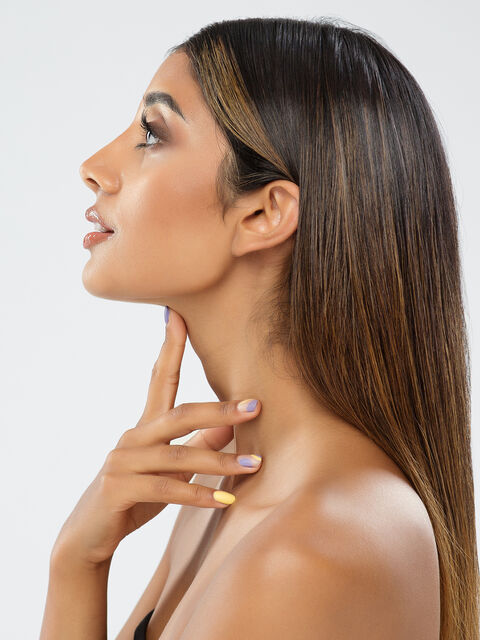
The procedure
Rhinoplasty in Newport Beach
Rhinoplasty — commonly called a nose job — is a surgical procedure that reshapes the nose to improve its appearance, its function, or both. It can reduce or increase the nose's size, refine its tip, narrow its bridge, straighten a deviation, smooth a dorsal hump, or correct breathing problems caused by structural issues inside the nose.
The nose is the most defining feature of the facial profile. Because it occupies the center of the face, even minor asymmetries or disproportions are conspicuous — and conversely, even subtle corrections can meaningfully improve how the entire face looks. Patients seek rhinoplasty for a wide range of reasons: some are bothered by a bump on the bridge, others by a tip that droops, others by a nose that appears too wide or too long for their face. Some have difficulty breathing through one or both nostrils. Many have thought about it for years.
Rhinoplasty is among the most technically demanding procedures in plastic surgery. The nose is a complex, three-dimensional structure of bone, cartilage, skin, and soft tissue, and changes to one area affect every other. This is why surgeon selection matters more for rhinoplasty than for perhaps any other cosmetic procedure — the difference between a natural result and a conspicuous one often comes down to judgment, experience, and restraint.
His approach
Structure, Proportion, Restraint
Every nose exists in context — its ideal shape depends on the rest of the face. A nose that looks right on one face would look wrong on another. Dr. Nichter's approach to rhinoplasty begins with this principle: the goal is a nose that fits, not a nose that follows a template.
During consultation, he evaluates the nose from every angle — front, profile, three-quarter, and base view — and assesses it in relationship to the chin, cheeks, forehead, and overall facial proportions. For patients whose profile would benefit from both a refined nose and a stronger chin, he may recommend combining rhinoplasty with chin augmentation — a classic pairing that addresses the profile as a whole.
His surgical technique is adapted to the individual anatomy. For most cosmetic rhinoplasties, he uses an open approach — a small incision at the base of the nose (the columella) that allows direct visualization of the nasal structures. This provides the precision needed to make the fine adjustments that define rhinoplasty outcomes: shaving a dorsal hump, refining a bulbous tip, narrowing the bridge with controlled osteotomies, or adjusting the angle between the nose and upper lip. For simpler corrections, a closed approach — with incisions entirely inside the nostrils — may be appropriate.
When the nose requires structural reinforcement — common in revision cases or when the existing cartilage framework is weak — Dr. Nichter uses cartilage grafts from the septum, ear, or, in complex cases, rib. These grafts provide internal support that maintains the nose's shape over time and prevents collapse.
His academic training and published research have given him a deep understanding of nasal anatomy and the long-term behavior of surgical changes to the nose. Rhinoplasty results evolve over months as tissues heal, cartilage settles, and swelling resolves. Knowing how the nose will look not at six weeks but at twelve months — and planning for that — is what separates experienced rhinoplasty surgeons from less seasoned ones.
Is it right for you
Am I a Good Candidate for Rhinoplasty?
Rhinoplasty is appropriate for patients who are dissatisfied with the appearance of their nose, who have breathing difficulties caused by structural issues, or both. The best candidates have specific concerns, realistic expectations, and a nose that has finished growing (typically by age fifteen or sixteen).
Rhinoplasty may be right for you if:
- A bump on the bridge (dorsal hump) bothers you in profile
- The tip of your nose droops, appears bulbous, or is asymmetric
- Your nose appears too wide, too long, or too large for your face
- You have difficulty breathing through one or both nostrils
- Your nose was injured and has not healed straight
- You had a previous rhinoplasty that did not produce the result you wanted
- You are in good overall health and do not smoke, or are willing to stop before surgery
Rhinoplasty is not appropriate for patients whose expectations are unrealistic — a nose can be refined and improved, but it cannot be made perfect or replicated from a photograph of someone else's face. Dr. Nichter will tell you if a different approach would better serve your goals.
What to expect
Your Rhinoplasty Experience
Consultation and Planning
Dr. Nichter examines your nose externally and internally, assessing bone structure, cartilage, skin thickness, nasal airway, and how the nose relates to the rest of your facial proportions. He discusses what you want to change, explains what is technically achievable, and develops a detailed surgical plan. If functional correction (breathing improvement) is part of the plan, he discusses septoplasty and its role. You leave with a clear understanding of the approach.
The Day of Your Procedure
Rhinoplasty is typically performed under general anesthesia. The procedure takes one and a half to three hours, depending on complexity.
For an open rhinoplasty, Dr. Nichter makes a small incision across the columella — the narrow strip of tissue between the nostrils — and internal incisions within each nostril. This allows him to lift the nasal skin and directly visualize the bone and cartilage framework. He then makes the planned modifications: reducing a dorsal hump by shaving bone and cartilage, narrowing the bridge through controlled osteotomies (precise bone fractures that allow repositioning), refining the tip by reshaping and suturing the lower lateral cartilages, and adjusting the nasal base if needed.
If the nasal septum is deviated and contributing to breathing difficulty, septoplasty is performed through the same approach — straightening the septum and removing obstructing tissue to improve airflow.
For a closed rhinoplasty, all incisions are placed inside the nostrils. This is suitable for less complex corrections and leaves no external scar.
If cartilage grafts are needed for structural support — from the septum, ear, or rib — they are harvested, shaped, and placed during the same procedure.
A splint is applied to the outside of the nose to protect and support its new shape during initial healing.
Immediately After
You are monitored as the anesthesia clears. Internal packing, if used, is typically removed within one to two days. The external splint remains for approximately one week. Expect swelling and bruising around the nose and under the eyes. A friend or family member will need to drive you home, and someone should stay with you for the first twenty-four hours.
Recovery
Recovery and Downtime
Rhinoplasty has a longer recovery arc than most facial procedures — not because the discomfort is greater, but because the nose takes many months to reveal its final shape. Patience is part of the process.
The First Few Days
Expect swelling, bruising around the eyes, and congestion. The nose will feel blocked due to internal swelling (and packing, if used). Discomfort is moderate — often described as pressure rather than sharp pain — and is manageable with prescribed medication. Keep your head elevated. Avoid blowing your nose, bending over, or lifting anything heavy. Sneeze through your mouth if needed.
Week One
The external splint is removed around day seven, revealing the early shape of the nose. Bruising under the eyes begins to fade. Swelling is still significant — the nose will look larger and less refined than it will ultimately be. Sutures at the columella (if open technique was used) are removed at this visit. Most patients feel well enough to be seen in public, though some prefer to wait a few more days.
Weeks Two Through Six
Most patients return to work within two weeks. Social bruising is largely resolved. The nose continues to be swollen — especially the tip, which is the last area to refine. Avoid eyeglasses resting on the bridge (use tape or a splint to float them). No contact sports or activities that risk impact to the nose. Light exercise can resume around week three to four, as cleared by Dr. Nichter.
Three Months to One Year
At three months, approximately 80% of the swelling has resolved and the general shape of the nose is visible. The remaining 20% — particularly in the tip and supratip area — resolves gradually over the following nine to twelve months. Patients with thicker nasal skin may take longer. The final result is typically evaluated at twelve to fourteen months after surgery.
Results
Natural, proportionate, permanent.
Rhinoplasty results emerge slowly. The general shape is visible once the splint is removed at one week, but the nose continues to refine for a full year as swelling resolves and cartilage settles. Semi-final results are typically apparent at three months. The definitive result — the nose at its final shape — is visible at approximately twelve to fourteen months.
The results of rhinoplasty are permanent. The structural changes to bone and cartilage do not revert. The nose will continue to age naturally — as does every part of the face — but the improvements in shape, proportion, and function are lasting. For patients who also had septoplasty, the improvement in breathing is typically noticeable within the first few weeks and is also permanent.
A well-performed rhinoplasty should not look like a rhinoplasty. The result should look like a nose that simply fits the face — proportionate, natural, and unremarkable in the best possible sense.
Open rhinoplasty (nose job) performed in Newport Beach, California for young female patient who was primarily concerned with the appearance of her profile. After photos taken at 6 weeks post-op.
This patient underwent a Rhinoplasty procedure in order to improve the appearance of the nose and/or the ability to breathe through the nose. The operation, therefore, may be considered cosmetic, functional, or for some patients both.
This patient underwent a nose surgery in order to improve the appearance of the nose and/or the ability to breathe through the nose. The operation, therefore, may be considered cosmetic, functional, or for some patients both.
Dr. Nichter performed a cosmetic and functional rhinoplasty to improve the patients breathing and appearance of her nose.
Investment
Cost and Financing
Rhinoplasty cost depends on the complexity of the procedure (primary vs. revision, open vs. closed), whether functional correction (septoplasty) is included, anesthesia, and whether it is combined with other treatments. Functional rhinoplasty for breathing impairment may be partially covered by insurance — Dr. Nichter's office can help you determine whether your case qualifies.
A detailed, transparent quote for the cosmetic component is provided after consultation.
Financing options are available — please ask at your consultation.
Common questions
Frequently Asked Questions
What is the difference between open and closed rhinoplasty?
Open rhinoplasty involves a small incision at the columella (the tissue between the nostrils), allowing the surgeon to lift the nasal skin and directly visualize the internal structures. Closed rhinoplasty places all incisions inside the nostrils, with no external scar. Open rhinoplasty provides more control and is preferred for complex corrections. Closed rhinoplasty is appropriate for simpler adjustments. Dr. Nichter recommends the approach best suited to your anatomy and goals.
Will rhinoplasty improve my breathing?
If breathing difficulty is caused by a structural issue — such as a deviated septum, enlarged turbinates, or nasal valve collapse — septoplasty or internal valve repair performed during rhinoplasty can significantly improve airflow. Many patients have both cosmetic and functional concerns addressed in a single procedure.
How long does rhinoplasty take?
One and a half to three hours, depending on the complexity. Revision rhinoplasty or cases requiring cartilage grafting may take longer.
Will the scar be visible?
With closed rhinoplasty, there is no external scar. With open rhinoplasty, the columella incision is small and heals to near-invisibility in most patients. It is typically not noticeable at conversational distance once fully healed.
How long until I see the final result?
The general shape is visible within a few weeks, but the nose continues to refine for twelve to fourteen months. The tip is the last area to reach its final shape. This is longer than most facial procedures — patience is an essential part of rhinoplasty recovery.
Can rhinoplasty be combined with other procedures?
Yes. It is most commonly combined with chin augmentation to refine the full profile, or with septoplasty to improve breathing. It can also be performed alongside a facelift or other facial procedures.
What is revision rhinoplasty?
Revision rhinoplasty corrects issues from a previous nose surgery — whether cosmetic dissatisfaction, breathing problems, or structural changes that developed during healing. It is technically more complex than primary rhinoplasty because the anatomy has already been altered and scar tissue is present. Dr. Nichter evaluates revision cases carefully and provides an honest assessment of what can be achieved.
Does insurance cover rhinoplasty?
Cosmetic rhinoplasty is not covered by insurance. However, if the procedure includes a functional component — such as septoplasty for a deviated septum or internal valve repair for breathing obstruction — that portion may be partially covered. Dr. Nichter's office can assist with insurance evaluation.
Schedule Your Consultation
If something about your nose has bothered you — whether for months or years — a consultation is a practical place to start. Dr. Nichter will evaluate your nasal anatomy, discuss what rhinoplasty can realistically achieve for your face, and answer every question. If breathing is a concern, he will assess that as well.
Request a Private ConsultationDr. Nichter sees patients from across the United States and internationally. The office is located in Newport Beach, CA.