Breast implant patients are eager to know more about the new Ideal Breast Implant, which is soon to be made available to the public. Dr. Larry Nichter, one of the lead FDA investigators into the safety and performance of the new implant, discusses the advantages offered by the latest breast implant in an interview with the American Society of Plastic Surgeons:
How is this implant superior to current saline or silicone breast implants?
The IDEAL IMPLANT was developed to combine the most desirable features of both current implants: the natural result of silicone gel with the safety of saline for “Peace of Mind.” It is what many women have been asking for – an improved saline implant, with the natural appearance and tissue-like feel of a silicone gel implant, but without the wrinkling, bouncing and globular look of the current single-lumen saline implant.
Why would a woman prefer this implant over current saline or silicone implants, or even future implants like the gummy bear silicone implants?
Many women considering breast augmentation would like to have only saline in their implants because of their feelings about health and safety. Scalloping or wrinkling is a well-known problem with current single-lumen saline implants. The only alternative women have for a more natural result is silicone gel-filled implants, which some will not accept, regardless of its “cohesivity.” This may be a significant part of the reason that 31% of US women chose saline-filled implants for breast augmentation in 2011. The IDEAL IMPLANT was designed to meet women’s need for an implant that gives a natural result, yet is filled with only saline.
Does the implant produce a more natural looking breast, as compared to current saline or silicone implants?
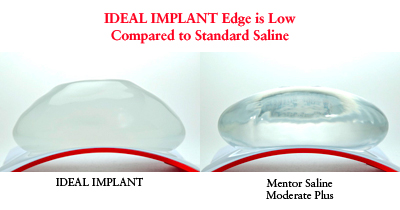
This new double-lumen saline implant was designed so the implant edge lies lower and closer to the convex chest wall, for a better contour to the chest wall than current single-lumen saline implants.
What are they made out of, i.e., do they still contain saline?
The IDEAL IMPLANT uses the same materials and manufacturing processes as current single-lumen saline implants. They are filled with only saline.
What is a double-lumen? What is an internal baffle structure and what is made out of?
Double-lumen means that the implant has two separate saline-filled lumens or spaces. An inner implant shell defines the inner lumen and the outer implant shell defines the outer lumen, which is between these two shells.
In the outer lumen, there are one to three implant shells, perforated and free-floating, that act as a baffle structure. This baffle structure is designed to control movement of the saline filler so there is no bouncing, to support the upper pole of the implant so it does not collapse when the patient is upright, and to support the edge of the implant so scalloping and wrinkling are minimized.
Does this implant look any different than current saline or silicone implants?
On the outside, it looks like any breast implant. On the inside, the IDEAL IMPLANT contains a series of implant shells of increasing size nested together (inner shell, outer shell and baffle shells in between).
Who is the manufacturer? Is this the first study done on this implant?
The manufacturer is Ideal Implant Incorporated, a company majority owned by plastic surgeons. The IDEAL IMPLANT is manufactured in the United States.
Is this the first study done on this implant?
Yes
Currently, where is this implants at in the FDA clinical trial process?
The PMA has been submitted to FDA in modules over the last year, including US clinical trial results, pre-clinical testing data and manufacturing information.
Approximately, how long until the implant will be available to patients?
FDA approval could be granted by year-end.
Will the cost of augmentation surgery with these new implants be comparable to current prices?
The IDEAL IMPLANT will be priced the same as current silicone gel implants and will be marketed directly to women. It will only be sold to ABPS certified plastic surgeons.
Download IDEAL Implant Core Clinical Trial Information
With the Ideal Implant, women will no longer have to choose between peace of mind and a great result when it comes to breast augmentation. Dr. Larry Nichter explains.
Saline and Silicone, Safety and Performance
Dr. Larry Nichter
Women have so far had essentially just two breast implant fill choices: saline or silicone.
Silicone implants have distinct advantages over saline implants in terms of performance: they wrinkle less and conform to a more natural breast shape, and also have a softer feel that is more breast-like. However, silicone implants have gained a reputation—possibly undeserved—for being less safe than saline implants. Despite the fact that there is no known toxicity of silicone gel breast implants, the possibility of a “silent rupture,” undetectable except by MRI, has been enough to make many women opt for saline implants or wait for a better product to come along. The time will be here most likely within a year or so with the advent of the Ideal Implant, the name given to a new design saline hybrid implant. It has the natural feel of silicone and safety of saline.
Saline implants, though providing peace of mind by being perceived as safer than silicone, often do not create a result that seems as natural. Wrinkling, scalloping, a globular shape, and water balloon-like feel, and increased risk of capsular contracture have been the trade-off for peace of mind with breast implants. The Ideal Implant solves many if not all of these concerns.
The Ideal Implant has both
The Ideal Implant is one of the major technological advances to come along in the past few decades in implant manufacture. Using a novel design with internal baffles, the saline implant is manufactured to achieve a similar feel and performance comparable to a silicone implant. Approximately 95% of both patients and their surgeons expressed satisfaction at the current two-year data point by the FDA. The Ideal Breast Implant is soon to be released in the US market, hopefully with in the year.
Image: idealimplant.com
As one of the lead FDA study investigators, I have personally followed my Ideal Implant patients for more than two years. The vast majority of my patients are thrilled with the results. My follow up exams indicate that in most cases they have the feel more like silicone than saline.
When placed on a convex surface similar to the curve of the chest wall, the Ideal Implant conforms to a more natural breast shape; its edge lies lower and its outward surface does not collapse. This is because engineers designed the Ideal Implant with three nested baffle shells, which are unattached and perforated. This makes the saline move slowly between the compartments, giving it gel-like characteristics and a feel more like that of a natural breast.
The Ideal breast implant uses no new materials or manufacturing processes—only tried and tested ones—and is made completely in the United States. The manufacturing process is automated to ensure uniform thickness of the membrane shell, unlike the hand-dipped ones that are used for breast implant manufacturers by other companies. Perhaps most important, the President of the Company, Dr. Robert Hamas, indicated that this implant will only be made available to board certified plastic surgeons by the American Board of Plastic Surgery. To date, the other saline breast implant companies in the US, Allergan and Mentor, sell their product essentially to any MD or DO whether they are a plastic surgeon or not, and even to non-surgeons without board certification. This gives an added advantage to the consumer knowing that when they have an Ideal breast implant placed it will be done by someone well trained and competent—by a board certified plastic surgeon.
The Ideal breast implant is currently undergoing FDA trial studies in 502 women, the second-year results were recently released and are very promising. The capsular contracture rate, for example, at the two-year follow up mark of the current FDA study indicates a dramatic decrease of capsular contracture. To date, the Ideal breast implants show significantly lower rates of capsule contracture and wrinkling, as well as high patient satisfaction. Deflations from early manufacturing defects were identified and addressed, and manufacturing processes have been refined.
Though it has yet to be released to the general public, the Ideal Implant is shaping up to be a contender in the open market with traditional saline and silicone implants.
To receive updates about the ideal implant or to be placed on Dr. Nichter’s waiting list for the procedure, please contact our office using the form below.
Use Clonidine Patches as directed by your doctor. Check the label on the medicine for exact dosing instructions.
You will apply the patch to a hairless area on the upper outer arm as directed by our office.
If your blood pressure is normal, it is usually applied two days prior to surgery and left on for one week. If directed to use one prior to that, it should be changed in 7 days if applicable. The area chosen should be free of cuts, scrapes, irritation, scars, and calluses. Do not place the patch on skin folds or under tight undergarments because it may come loose. If more than one patch is prescribed then the new patch should be placed on a different skin site from the previous site.
Wash your hands with soap and water and dry them completely before applying Clonidine Patches.
Clean the chosen application area with soap and water. Rinse the area and wipe it with a clean, dry tissue.
Remove the patch from the pouch. Remove the clear plastic protective backing from the pouch by gently peeling off one half of the backing at a time. Avoid touching the sticky side of the patch.
Place the patch on the skin site (sticky side down) by applying firm pressure on top of the patch. The adhesive overlay does not contain any medicine and should not be used alone.
Wash your hands with soap and water to remove any medication that may be on your hands.
If the patch does not stick firmly or begins to come loose, apply the adhesive overlay on top of the patch. The adhesive overlay does not contain any medicine and should not be used alone.
After removing the used patch, fold it in half with the sticky sides together. Discard the patch out of the reach of children and away from pets. Even after it has been used, the patch contains active medicine, which may be harmful if accidentally applied or ingested.
Continue to use Clonidine Patches even if you feel well.
Best Scar Management is important to minimize or completely hide from view, the telltale signs of your surgery—namely, scars. Both you and your surgeon want you to have the most minimal scarring possible. There are many possible causes for scars that are enlarged or not healing well. Unsightly scars are most commonly due to genetics, underlying medical conditions, or improper scar/wound care. The last part is very important and patients can make a noticeable difference in their scars’ appearance by following best scar management practices. Here are some simple tips.
Scar Management tips:
Minimize tension on the scar. Steri-Strips and/or surgical tape are often placed in non-hair bearing areas at the time of surgery to minimize tension and keep pressure over the scar. This minimizes the stress that can pull the scar apart (dehiscence) creating a wound and delaying healing time, and can make the scar wider, or more “ropy”. In the first few weeks after surgery, I recommend the use of Embrace Scar Therapy which is an adherent silicone sheeting pre-stretched when applied so as to offload tension on the scar.
Keep your incision site/scar clean to prevent infection. Follow your surgeon’s wound care instructions to the letter with out modification. Never apply different products then recommended without first discussing them with your surgeon. This is especially important during the first few weeks. If there are any signs of infection, contact your surgeon’s office right away and/or see your doctor or his nurse immediately. Typical signs of infection may include redness outside the immediate incision site, asymmetric swelling, and drainage, of pus, fever, chills, and “feeling sick”.
Protect your scars from the sun. Staying out of the sun is the best advice. Minimal exposure to sunlight is prevents hyperpigmentation (permanently turning brown) and other problems that can make the scar more noticeable. Sunscreen, at least 30 SPF and an overlying make camouflage make up additionally protects the scar from the suns harmful rays. This advice is especially important the first year following your surgery.
Use specific scar maturation products recommended by your surgeon. Patients seem to have their own opinions on this touting everything from Pure Vit E, Coco butter, to Aloe Vera, etc but most have minimal benefit other than keeping the scar hydrated. Although hydration is important there are better, scientifically studied products with greater efficacy. Most of the scientific articles written about this subject indicate that topical silicone gel or silicone sheets work the best. The best product available in my opinion is the Embrace Scar Therapy System by Neodyne BioSciences, Inc. available in many surgeons’ offices. Essentially this is an adherent silicone sheeting pre-stretched when applied so as to offload tension on the scar. For areas that are not applicable for this product (e.g. smaller areas or on the face), I prefer BioCorneum or Kelo-Cote products There are a lot of products to choose from, but silicone should be one of the key ingredients. Although Mederma, an onion extract derivative active ingredient rather than mainly silicone based may help, primarily silicone based products are better and many also contain other ingredients that may be synergistic (hydrocortisone or other steroid, Vitamin E, Sunscreen, etc).. If the reader has problems obtaining these they can call my office. Patient compliance is also critical – use often and according to directions or it will not work optimally. NEVER apply products without first discussing them with your surgeon.
Monitor to make sure your scar is progressing optimally. Keep your scheduled follow-up appointments with your surgeon to verify that your scars are maturing as expected. Occasionally if indicated you may need a topical steroid preparation or even a series of injections (5-FU and/or Steroids) or laser treatments to treat or prevent scar hypertrophy or keloid formation (red raised scars), or other topical medicines to treat post inflammatory hyperpigmentation (brown scars) with prescription creams and possible laser treatments.
The most critical decision to be made in achieving the best plastic surgical result is picking the most experienced and talented, that is the best, plastic surgeon possible. Too often, patients choose a physician based on a catchy ad, the brand name of a technique, the basis of one or two before and after photos, or their web site’s search engine ranking. These criteria will not find the most experienced and talented plastic surgeon.
My Background
Dr. Larry Nichter
I have been a practicing plastic surgeon for more than 25 years, having trained scores of plastic surgeons as a tenured professor of plastic surgery at USC, and I have had a private practice in Orange County since 1993. Speaking from all this experience, here is my advice and the criteria I would use to find the best plastic surgeon in Orange County, Los Angeles, California, or anywhere in the United States. These are the criteria I would use to select a plastic surgeon for my friends, my family, or myself.
First, I want to stress some general observations I have found to be true over the years.
Caveat Emptor: Buyer Beware
The longer a surgeon trains at his craft, the finer his skills and the better his judgment become. Board certification in Plastic Surgery (see below) is a bare minimum. Board certification in an additional surgical field recognized by the American Board of Medical Specialties, or for that matter “triple-board certified,” attests to a doctor’s advanced training and skill and judgment. It also means that they have attained Chief Resident Status in more than one field during their training which means they essentially ran a large departmental service and had senior decision-making and independent operating responsibilities. It is this step that is most maturing for a surgeon.
The institution where the surgeon trained is also important. More renowned schools usually attract the best faculty.
You can use the internet to research the background of a prospective plastic surgeon quickly. Please do this prior to making an appointment. “Just because you wear a baseball cap it doesn’t mean you are a good ball player.” The same applies to anyone wearing a white coat—it doesn’t make you a plastic surgeon, much less a great one.
Caveat Emptor in Latin means “Buyer Beware.” In most states, including California, any physician with a medical school diploma and state license is viewed as a doctor and a surgeon—even without any formal surgical training. In some cases even doctors who have completed only the minimal requirements (medical school, licensing examination, and a one-year internship that need not include surgical training) are touting themselves as “cosmetic surgical experts.” They make these claims of expertise despite the fact that they are only formally trained as family practitioners, OB/Gyns, emergency physicians, dermatologists, or ear-nose-throat specialists. Even physician assistants and nurses have made such claims.
7-Step Process for Finding the Best Plastic Surgeon
The following are my screening guidelines and criteria for picking the best plastic/cosmetic surgeon.
1. Board Certified Plastic Surgeon by the American Board of Plastic Surgery
To become a plastic surgeon certified by the American Board of Plastic Surgery requires a minimum of five years of surgical training with a minimum of two years of training specifically in plastic surgery. Then the applicant must also pass a comprehensive written board exam. If successful, the candidate must present his/her clinical cases for critical review by board examiners (I was one such board examiner) and if accepted will take a series of oral examinations.
Since the 1990s, the American Board of Plastic Surgery Certification is only valid for ten years. To retain your board certified status, a plastic surgeon must complete a Maintenance of Certification including written testing and case review. This means that all who pass are trained and experienced in all plastic surgery procedures including facial procedures, breast, and body; essentially all cosmetic and reconstructive procedures.
If a Plastic Surgeon is additionally board certified by another surgical specialty recognized the American Board of Medical Specialties, then this also marks additional expertise and training at the highest level. The American Board of Facial Plastic Surgery (ABFRS) is not a licensing body nor an educational institution and the certificates it issues are not legal licenses to practice facial plastic and reconstructive surgery. The ABFRS is not recognized by the American Board of Medical Specialties (although it does note additional specialty training/interest in facial aesthetic surgery).
Likewise, beware of physicians armed only with certification from other non-ABMS recognized boards or special society memberships other than those I have recommended (eg. “Cosmetic Surgery Board,” “Lipoplasty Society of North America,” etc.).
2. Fellow of the American College of Surgeons: FACS
The American College of Surgeons is dedicated to improving the care of the patient and to safeguarding standards of care in an optimal and ethical practice environment. Members of the American College of Surgeons are referred to as “Fellows.” The letters FACS (Fellow, American College of Surgeons) after a surgeon’s name mean that the surgeon’s education and training, professional qualifications, surgical competence, and ethical conduct have passed a rigorous evaluation, and have been found to be consistent with the high standards established and demanded by the College.
To be a member you have to:
be board certified in a surgical specialty recognized by the American Board of Medical Specialties
be in practice in one location for a number of years, with a background check, nomination, and interviews which verify that you are an ethical and safe surgeon among other criteria.
Hint: Look for the “FACS” (or “FRCS,” see below) after the “MD” in a doctor’s title or in his/her Curriculum Vitae to see if he/she is a “real surgeon.”
Note for patients in Canada: The equivalent of FACS in Canada is the Royal College of Physicians and Surgeons of Canada, FRCS.
3. Member of the American Society of Plastic Surgeons (ASPS)
The American Society of Plastic Surgeons is the largest organization of plastic surgeons in the United States and one of the largest in the world. ASPS members are uniquely qualified because of the society’s membership requirements:
Members of the American Society of Plastic Surgeons must be Board Certified by The American Board of Plastic Surgery complete at least 5 years of surgical training with a minimum of 2 years of training specifically in plastic surgery. The more years of Plastic Surgical Training the better – this includes fellowships in a plastic surgical field.
American Society of Plastic Surgeons members are required to adhere to a strict code of ethics and must fulfill rigorous Continuing Medical Education (CME) requirements including patient safety issues.
Beware of physicians without this membership but belonging only to similar-sounding societies as their claim to excellence eg. “American Society of Cosmetic Surgery,” “Lipoplasty Society of North America,” etc.
4. Member of the American Society for Aesthetic Plastic Surgery (ASAPS)
This is the most elite society in the United States and perhaps the world for Aesthetic Plastic Surgery. To be a member means that your career is focused in cosmetic surgery at the highest level. Among the requirements for invitation and election to ASAPS membership, a plastic surgeon must:
Be certified by the American Board of Plastic Surgery (or in plastic surgery by the Royal College of Physicians and Surgeons of Canada);
Be in at least the third year of active practice following board certification;
Participate in accredited Continuing Medical Education (CME) to stay current with developments in the field of cosmetic plastic surgery and patient safety;
Document the performance of a significant number and variety of cosmetic surgical cases to demonstrate wide experience;
Be sponsored by two ASAPS-member plastic surgeons to help ensure that the applicant’s professional reputation meets the high standards required by ASAPS;
Adhere to current ethical standards for professional conduct as outlined in the Code of Ethics observed by all ASAPS-member surgeons;
Operate in accredited surgical facilities; and
Be elected by at least 80% of the Active Membership.
5. Hospital privileges to perform the same type of surgery
Hospitals often examine qualifications of doctors applying for hospital staff privileges and restrict privileges to only surgeons best trained and qualified to do certain procedures. For example, in order for surgeons to be granted plastic surgery privileges in most hospitals in Orange County, California, that surgeon must have completed plastic surgery residency training and must be board-eligible or -certified in plastic surgery to be allowed to perform plastic surgical operations in that hospital.
Non-surgeons and other physicians that are not plastic surgeons circumvent this process by performing surgery in their offices or in outpatient surgery centers where the credentialing process is less rigorous or nonexistent. In these settings non-plastic surgeons perform procedures in which they have no formal residency training.
I am not warning against use of outpatient surgery centers or in-office procedures. I am only recommending that you check that your physician has hospital privileges for these same procedures.
6. Surgical Experience in the procedure you are having
Few patients ask how long doctors have been doing a certain procedure or how many they have performed. When you consult with a plastic surgeon:
Ask to see typical “before and after” photos;
discuss the details of the procedure in a manner that is clear to you;
review benefits and potential complications;
get full answers to your questions.
7. Evidence of Excellence, Experience and Commitment to the field of Plastic Surgery
Here are some additional criteria to look for in your plastic surgeon.
Surgical Board Certification in more than one field
Plastic Surgical Fellowships in addition to Plastic Surgical Residency.
Number of years practicing.
Peer Review Honors in their own board certification from groups such as Best Doctors, Top Doctors, Super Doctors.
Current or Prior position denoting excellence in the field or high regard by their peers such as:
Prior or present Professor or Faculty affiliation with a University Plastic surgical program (the higher the rank the better)
Chairman of a Department of plastic surgery at a regional hospital
Honors from surgical societies of which they are members such as Board Examiner, etc.
Published Plastic Surgical papers in peer review journals are also a good sign that they are committed to being on top of their field.
Feel Comfortable with your choice
It is very important that after you have done this screening and met with your potential surgeon that you feel confident in your choice.
Complications are not common in cosmetic surgery, but if one did occur are you confident that this surgeon would take charge and handle just about any problem?
Do you feel that he listens to you and communicates well by answering your questions completely, doesn’t rush you in to a decision but rather makes you part of the decision-making process? You should truly feel that it is a combined effort.
Does the surgeon’s office run smoothly? Do the staff take good care of you? If you answered in the affirmative and have gotten this far in your screening guidelines then I think you have found your “Dr. Right.”
A compression garment is required and beneficial after liposuction because:
It restricts the amount of edema that forms and hastens its resolution by mechanical pressure.
It decreases the amount of bruising.
It assists the loose skin in retracting or shrinking.
It is common to have weight gain due to edema, serum that collects in the area, and the tumescent fluid that was injected. This will resolve over time. The more you wear the garment initially, the quicker this fluid resolves.
Edema: a condition characterized by an excess of watery fluid collecting in the cavities or tissues of the body.
The length of time that the garment should be worn varies depending on the amount of fat removed, the elastic nature of your skin, how much loose skin remains, and other factors. Your surgeon would give you the best advice, however this is the general routine for my patients.
The first garment should be fitted for you in the office prior to surgery and applied in the operating room. Often it will become loose as the edema is mobilized, and then it will need to be replaced. Spanx is a reasonable compression garment if it gives enough support and is the right size. I have my patents bring them in so I can confirm that it fits well.
Most important advice is to listen to your surgeon, as he or she knows how much fat was removed, the elasticity that remains in your skin, and amount of skin redundancy.
I recommend that my patients wear their garments for a minimum of three weeks full time then for twelve hours at a time (day or night). If there is not a lot of redundant skin, this continues to a maximum of six weeks.
To be effective, the garment needs to fit snugly—but not too tight as that can make it difficult to sleep or cause pressure problems (inspect your skin when it is exposed if you are uncomfortable). As the edema resolves it is common for patients to switch to a smaller garment that fits. A Spanx-type garment would work fine, rather than ordering one or paying more at your doctor’s office.
Many of my patients ask about supplements that can speed the healing process. One such supplement that I feel is efficacious, decreases bruising and speeds healing is Bromelain. Below is a summary that details some of its potential beneficial qualities.
Pineapple plant. Image: Wikimedia Commons
Bromelain is a type of enzyme found in high concentrations in pineapple plants (and other plants of the plant family Bomeliaceae). Animal studies and anecdotal evidence of the medicinal properties of this pineapple plant extract have brought to light its therapeutic value. Bromelain has also been shown to have low toxicity and produces little to no undesirable side effects.
Evidence from decades of research suggests that bromelain is effective at:
reducing pain
reducing edema
reducing inflammation
improving the potency of antibiotics.
All of these properties are related to important aspects of post-operative healing.
The FDA in the United States recognizes bromelain as generally safe, and has categorized it as a food additive. It is commercially available in capsule, tablet, powder, and liquid forms for oral consumption. The recommended dosage varies between 500 to 1,500 milligrams per day.
Evidence from early studies indicate that bromelain may be an effective pain reducer. Healthy adults showed a dose-dependent response to the extract, which reduced acute knee pain and appeared to promote their general well-being. Bromelain reduced pain when applied directly to open blisters in another study.
Bromelain may reduce healing time for soft-tissue wounds. Patients in one controlled clinical trial who took Bromelain had bruising and faster reduction of edema than patients who did not. Analysis of the results, however, showed that the effect fell short of statistical significance. Results from another study showed that patients who took vitamin supplements containing Bromelain had shortened wound-healing time than those who did not.
Bromelain enhances the action of antibiotics. An early study suggested that Bromelain makes tissues more permeable to antibiotics but the results were not statistically significant. Another study, in children, found that Bromelain significantly reduced healing time for sepsis by potentiating the antibiotics.
Studies of Bromelain’s toxicity have found it to be very low. Some reports of “gastrointestinal problems, headache, tiredness, dry mouth, skin rash, and unspecified allergic reactions” have been cited as possible side effects of high doses of Bromelain. Then again, some of these symptoms are seen with placebos. Higher doses have been correlated with stronger side effects. Overall, there have been few reports of adverse effects.
Dr. Larry Nichter
More controlled clinical trials will have to return statistically significant results before Bromelain is accepted for therapeutic purposes. The extent of its efficacy and the mechanisms by which it works must be better understood. However, because of its potential, bromelain has caught the attention of the medical community and will be the object of future research.
I hope you have found this helpful and now understand why I recommend Bromelain to my patients.
—Larry S. Nichter, MD
Citations:
Orsini, Roger A. “Safety & Efficacy Report: Bromelain.” Plastic and Reconstructive Surgery 118.71 Dec. (2006): 1640-44. Print.
Post operative nausea and vomiting (PONV) is a serious problem for patients who are undergoing elective surgery. For facial aesthetic surgery PONV can lead to hematoma, delayed healing times, and other complications not the least of which is patient suffering.
Our focused interest in this problem was motivated by the progressive increase of PONV despite liberal use of antiemetics such as Odansetron (Zofran). At the same time we noted the increasing prevalence of antidepressant medications taken by our patients.
Based on our experience and extensive review of the literature we have established a perioperative treatment protocol that is beneficial to your patients and their well being.
Serotonin Syndrome is a poorly recognized but potentially dangerous condition which in its early stages may include nausea and vomiting (PONV) , hypertension, fever, tachycardia, agitation, restlessness, insomnia, mental status changes, diarrhea, etc. All of these are dangerous in the post operative healing period.
Serotonin Syndrome occurs when two or more drugs are taken together and cause too much available serotonin. Antidepressants (including selective serotonin reuptake inhibitors (SSRI), selective serotonin/norepinephrine reuptake inhibitors (SSNRI), and monamine oxidase inhibitors (MAOI); Migriane Triptan medications including Imitrex, Relpax and others. Pain medications: (especially Tramadol), opioids; antiemetics such as odansetron (Zofran); and even cough medicines with dextromethorphan have been implicated in Serotonin Syndrome.
When your patients, who have been appropriately prescribed these medications, are then given certain pain medications or antiemetics they may develop serotonin syndrome and PONV.
We are attaching a table listing some of the multiple drug classes that have been implicated in this syndrome. In order to keep Serotonin Syndrome from occurring in our patients, we use the protocol attached. This includes the use of Cyproheptadine (periactin) as prophylactic when serotonin medications are used.
We your taking note of these guidelines during the postoperative period and contact us directly if you have any concerns or suggestions.
Want to enlarge or improve your breasts with your own fat?
For years, Plastic Surgeons and their patients have desired to transfer unwanted fat from their tummy or thighs to their breasts. We are now are able to do this safely.
If you have been considering a Breast Lift or improving your appearance after breast augmentation or Breast Reconstruction but are not comfortable with introducing artificial material into your body, you may want to look into the benefits of breast augmentation with fat transfer. An alternative to breast implants is fat transfer also known as fat grafting or lipoinjection. This technique allows women the option of enhancing the appearance of their breasts without the potential problems of saline or silicone implants such as hardness, rippling or rupture.
Who is a candidate?
Any woman who is healthy
Women with sufficient body fat for the procedure
Women considering breast augmentation who wish to be one cup size larger or less
Women who have had breast augmentation or reconstruction but who lack fullness or have contour concerns. Fat transfer can further enhance and reshape your breasts while smoothing out visible or palpable edges of breast implants. This will disguise implant rippling and wrinkling.
Women with normal mammography
Dr. Nichter has successfully transplanted fat into the face, buttocks and other body areas for decades and are now using this same technology to enhance breast shape and size. Plastic surgeons have been transplanting fat to the breast since 1995 but caution and study were necessary to make sure there were not harmful effects. Furthermore, results in the past were variable, dependent on surgical equipment, technique, surgeon’s skill, and individual patients healing abilities.
Since 1995, recent advances have led to the development of special instruments made just for fat grafting. Dr Nichter uses his decades of experience and advanced knowledge of this technique to transfer body fat from other unwanted areas to the breasts. Though this procedure is still considered investigational to a degree, more and more qualified plastic surgeons are using this technique successfully. The advantage of this technique is its ability to create a natural augmentation without an implant. Fat grafting (also called lipoinjection or fat transfer) to the breasts is indicated for different reasons: as an alternative to implants for mild to moderate breast augmentations, to provide fullness to the upper part of the breast during a breast lift, after pregnancy, age, or weight loss, following breast reconstruction, or to minimize the visibility or rippling of existing breast implants. Typically up to one breast size enlargement is possible in most patients. Fat transfer to the breast is usually done as a single procedure resulting in approximately half a cup volume increase. In women desiring additional breast enhancement a subsequent procedure can be performed. Each surgery consists of two components:
Harvesting the fat: Fat is removed from your abdomen, hips, “love handles” or other areas using a fine cannula similar to the one used for liposuction but skinnier. This fat is rinsed with sterile saline solution and then packaged into syringes and prepared for transfer. Approximately 20% of fat removed is suitable and available for fat grafting.
Fat transfer into the breasts: The prepared fat is injected in small amounts at a time and widely distributed within the layers of the breast so that these living fat cells can pick up a healthy new blood supply.
Advantages of Fat Transfer to the breasts:
Fat cells are natural and you are using your own tissue without any foreign body or implant.
Harvesting of the fat by liposuction has the added benefit to enhance your shape by removing unwanted fatty deposits
The breast can be shaped or sculpted in more detail than is possible using implants alone.
Minimal incisions reduce the possibility and degree of scarring
No implant is used, therefore there is never a need for replacement, or any potential for capsular contracture (hardening of the implant).
Fast Recovery Time: Recovery time is about 1 week and usually less uncomfortable from implants that are placed beneath the muscle.
Although, breast augmentation performed with the lipoinjection technique takes longer than traditional breast augmentation (with implants) the benefits are substantial including no need for implant replacement in the future.
In the past, significant questions were raised about the ability of Mammograms or MRI to detect breast cancer after injecting fat into the breast. However, there is no evidence that fat transfer to the breast is less safe than any breast surgery. Large studies have begun over the last several years to study fat grafting to the breast. With or without breast surgery, calcifications and lumps can occur. Breast diagnostic studies including physical examination and mammograms should be used to monitor every patient diligently using standard guidelines.
As a general rule, surgeons with extensive experience in grafting large volumes of fat to the body are most likely to obtain the best results. We believe fat transfer should only be performed by surgeons certified by the American Board of Plastic Surgery that have experience in fat grafting. Few plastic surgeons have this experience. This ensures that your surgeon has advanced knowledge and technical familiarity, but also the subtle anatomy and aesthetics of breast augmentation.
Our patients remain the biggest source of our referrals. Over time they continue to remain thrilled with their results from these and similar procedures. I continue to share their enthusiasm and appreciate their long lasting rejuvenation which seems to affect them inside and out.
—Larry S. Nichter, MD, MS, FACS
For more information about the No Implant Breast Augmentation by fat grafting or other cosmetic procedures performed by Dr. Nichter call our office number: (949) 720-3888.
Minimally invasive procedures are the focus of all surgical fields and plastic surgery is no exception. The trend for looking your best has moved towards procedures that have rapid healing times, reduced risk and leave significantly less scarring than traditional methods. More importantly, most patients want a natural, refreshed look without the appearance of having had surgery. The Lite-Lift™, modified facelift procedure, exemplifies these principles by having 40% less scarring, and nearly half the surgical down time. Rather than being performed with general anesthesia, most are performed in our office with oral sedation and local anesthesia without an IV. Dr. Nichter is an expert in this technique and is able to tailor your rejuvenation to better achieve the patient’s desired results.
It seems rational that the more extensive a procedure is, the more dramatic and long lasting the outcome will be but this is not always true. Though there is still a place for the traditional facelift, with it there is also increased recovery time and potential for problems. By using advanced techniques deep to the skin, we are able to minimize external skin incisions and scarring. For example, placing the scar within portions of the ear and ending the incision behind the earlobe crease eliminates the usual telltale scar of a full facelift. Similarly, repositioning the incisions to hide them is also used. For example, beveling the incisions just behind the hairline allows the sideburn not to be displaced too high while allowing hair to grow through the scar to conceal it. In contrast to the traditional facelift, the Lite-Lift™ re-draping of skin is upward, a more natural, antigravity, direction eliminating the “swept away” unnatural pull too often seen in Hollywood stars with older facelift techniques. These and other advanced techniques along with modifications and innovations by Dr. Nichter is what make up the essence of the Lite Lift™.
The techniques of the Lite Lift are advanced and predictable in the most skilled hands of Plastic Surgeons Board Certified by the American Board of Plastic Surgery of which Dr. Nichter is a member. The best candidates are those patients with some remaining skin elasticity (late 30’s to 60’s) but this technique is also applicable to most patients including those in good health but advanced age. Best of all, this technique can incorporate synergistic procedures such as blepharoplasty (eyelid lift), temple/brow lift, cheek lift, and liposuction of the neck and jaw line, chemical peels and more. These added procedures heal simultaneously so a speedy recovery is expected.
Our patients remain our biggest source of our referrals. Over time they remain thrilled with their Lite-Lift™ results. I share their enthusiasm and appreciate their long lasting rejuvenation which affects them inside and out.
—Larry S. Nichter, MD, MS, FACS
For more information about the Lite-Lift™ or other cosmetic procedures performed by Dr Nichter, call our office number: (714) 902 1100 or visit our dedicated website: LiteLiftDr.com.